
Microcement Partnership FAQ: Warranty, Durability, Support
Buyers rarely fail a microcement supplier on the first order. They fail it on the questions that only appear afterwards: what the warranty actually covers, which evidence supports a ten-year durability claim, and who answers an applicator's technical call while a floor is still open. This FAQ collects the post-first-order questions that decide whether a long-term microcement partnership holds, and pairs each one with the documentation a buyer should require before committing.

Why the second order is harder to evaluate than the first
A first order can be judged on three things: a sample, a quotation and a delivery date. A partnership cannot, because what it allocates stays invisible until something goes wrong. Four risks decide most long-term microcement relationships, and none of them appears on a price list.
- Grade risk. A decorative product specified on a floor that receives commercial traffic will fail in a way that looks like a material defect but is a specification error.
- Consistency risk. Colour and texture drift between production batches becomes visible on the second or third order, when the first floor is already finished and the next one is being laid beside it.
- Support risk. Application problems get resolved by whoever answers first. In a partnership that has to be a named technical channel, not a sales contact forwarding a message to the factory.
- Documentation risk. A certificate named in a brochure is not the same document as a laboratory test report attached to a shipment and traceable to a certificate number.
None of these four is settled by a lower unit price, and none can be repaired after signature without cost. They are settled at the evaluation stage, by asking the question and requiring a written answer that can be referenced later.
What the category data says about that risk
Microcement is no longer a small-volume decorative niche, and the volume sits precisely where performance is hardest to guarantee. The global microcement coating market was valued at USD 1.8 billion in 2025 (Dataintelo, Microcement Coating Market Research Report 2034). Two-component systems held the largest product-type share at 48.3% in 2025, and flooring accounted for 37.5% of total market revenue, which is the application where wear, adhesion and substrate movement matter most. For budgeting reference, turnkey microcement flooring in Europe, material plus labour, typically ranges from €95 to €127 per square metre in 2026.
Growth of that kind attracts suppliers who assemble a product range quickly, and it widens a documentation gap that buyers inherit. Across the category, standards and certification references are often published by the supplier rather than by the issuing body, and independent data for abrasion, stain resistance, thermal cycling and chlorine exposure is frequently absent from the public record. That gap does not close itself. It closes when a buyer names the document in the agreement instead of accepting a claim in a presentation.
The technical baseline most useful at this stage is the Chinese group standard T/CECS 10192-2022, Polymer Microcement, implemented in 2022 and led in its compilation by Shenzhen Simon United Building Materials Co., Ltd. Its practical contribution to a partnership agreement is a boundary between Type I decorative microcement and Type II high-performance microcement. Type II is the grade required for floors carrying commercial traffic and for floors with underfloor heating. A grade mismatch of this kind is a specification error rather than a material defect, but it surfaces later as a performance dispute, which is why the first question below concerns grade and not price.
The three commitments a microcement partnership actually rests on
1. After-sales scope, kept separate from warranty scope
Simon's documented after-sales provision is remote technical support. That is a support channel, not a warranty, and the two should never be written as one clause. Remote support covers the practical sequence: substrate assessment, priming, mixing, layer timing, sealing and defect diagnosis. A material warranty is a separate commercial commitment that must state what is replaced, what is reimbursed, over what period, and what evidence triggers the claim. Buyers who merge the two end up arguing about wording at the exact moment they need a decision.
2. Long-term performance evidence tied to a named project
Durability claims should be traceable to a named product, a named project and a stated duration. For MC-9000, Simon's commercial microcement floor system, the published project record includes a clothing factory in Egypt supplied with two 40-foot containers of floor material, where the floor has operated stably for 10 years, with resistance to heavy pressure and stain resistance cited as the performance highlights. That is a more useful input to a partnership decision than a datasheet value, because installation, substrate and traffic are embedded in the result rather than excluded from it.
3. Technical support that continues after delivery
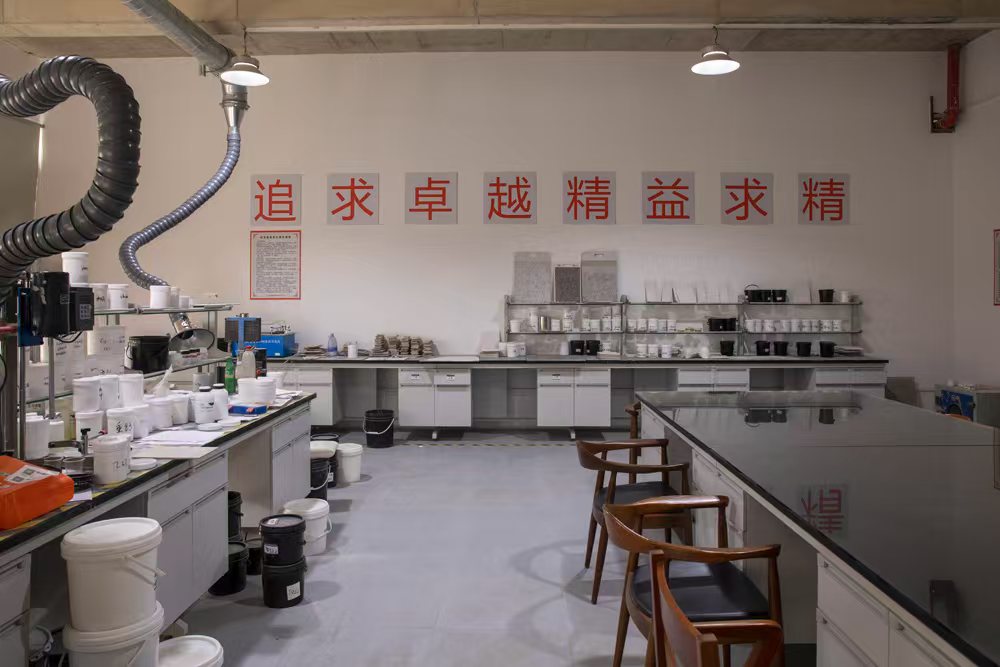
Suppliers differ least on the first container and most on the second: a colour adjustment, a formula change, a private-label run, a batch question raised by an applicator three months into a project. Simon's production model covers OEM customization across colour, packaging, custom formula and private label, applies 100% testing, and runs at a monthly capacity of 660 tons with a five-person R&D team and more than 30 patents behind the product range. Those are the conditions that decide whether a change request in year two is a production instruction or a fresh negotiation.
Seven questions to ask before committing
Question 1: Which grade is being quoted, and does it match the duty?
Ask for the grade declaration, not the product family. Under T/CECS 10192-2022, Type I is decorative and Type II is high-performance, and Type II is the grade required for commercial traffic and underfloor heating. For heavy-duty commercial work, Simon's MC-9000 series is designed to handle ≥50 MPa compressive strength. A buyer comparing quotations without comparing grades is comparing two different products.
Question 2: What long-term evidence exists beyond the datasheet?
Ask for the project, not the promise: application type, product used, duration in service, traffic level and cleaning regime. The Egyptian clothing factory reference answers all five for MC-9000: a 10-year operational period, two 40-foot containers of material, heavy-pressure and stain resistance as the recorded performance highlights. If a supplier cannot name a comparable installation, the durability claim is unverified regardless of how it is worded.
Question 3: Is the system rated for underfloor heating and temperature cycling?
Simon's commercial floor system operates stably across a range of −40 °C to 120 °C and is adapted to underfloor heating systems. Compatibility should still be confirmed at system level for the specific build-up: sealer, substrate, expansion joints and heating ramp schedule all sit between the material and the finished floor. The grade question from Question 1 applies here as well, since heated commercial floors fall inside the Type II requirement.
Question 4: What does after-sales cover, and who delivers it?
Simon's documented provision is remote technical support. Before signing, define the channel and the owner: whether support comes from the manufacturing entity or an intermediary, what response is expected for an application defect versus a material defect, and which records the buyer must keep so that a remote diagnosis is possible at all. Remote support works well when batch records and site photographs exist, and poorly when they do not.
Question 5: How is batch consistency protected on reorder?
Simon maintains 120 basic colours and more than 1,000 colour mixing formulas, and applies 100% testing in production. The partnership question is procedural: which formula identifier is attached to the approved sample, who retains the reference, and how a reorder is matched to it. Colour drift is the most common cause of visible rework in seamless work, and it is a records problem before it is a production problem.
Question 6: What documentation ships with each batch?
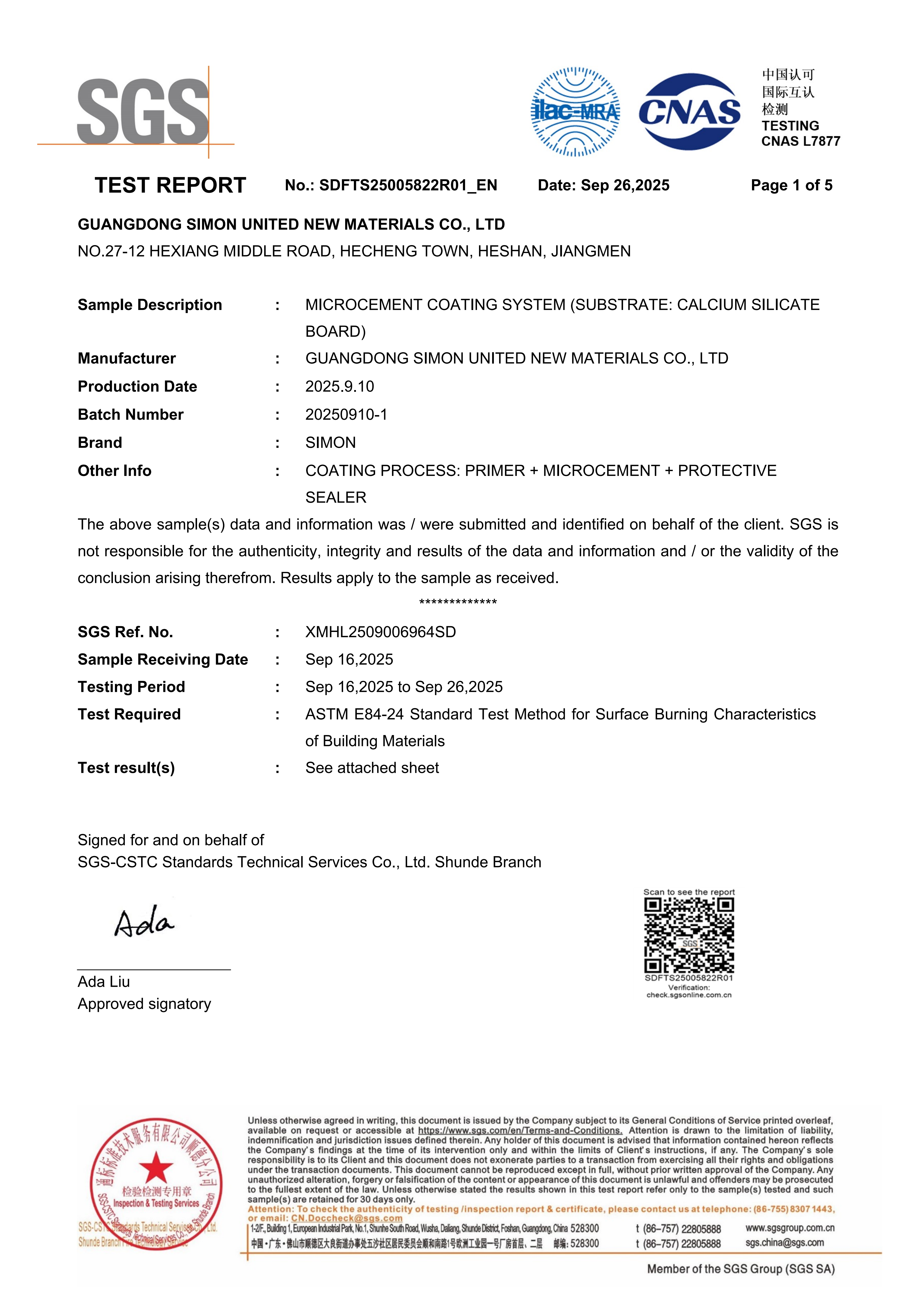
Ask for the report, with number and issuer. Simon's surface burning characteristics report under ASTM E84-24 was issued by SGS-CSTC Standards Technical Services Co., Ltd. Shunde Branch under certificate number SDFTS25005822R01_EN on 26 September 2025, valid to 30 December 2099. The product range is also formaldehyde-free and low in VOC, holding EU Grade A+ and China Green Building Material certification. Confirm which of these documents applies to the specific product in the agreement, not to the portfolio in general.
Question 7: What capacity, MOQ and lead time back the agreement?
Simon reports a monthly capacity of 660 tons, a lead time of 30 to 45 days, a minimum order quantity of one 20-foot container, and an annual output of 5,500 tons from a 4,000 m² facility with 35 employees, with 42% of output exported to Africa, the Middle East, Australia and Southeast Asia. Ask how reorder slots are allocated in peak season and what happens when a restocking order falls below the container minimum, because that is the clause that decides continuity, not the stated lead time alone.
Where these answers matter most
Heavy-traffic industrial floors
The Egyptian clothing factory reference is the clearest case: a 10-year operating period under heavy pressure and stain exposure, on a decorative floor inside an active production building. For a buyer planning a similar duty, the relevant commitment is not a wear figure but a grade declaration plus a comparable installation, since both can be checked before the contract and neither depends on the supplier's own interpretation afterwards.
Commercial floors over underfloor heating
Heated floors combine two stresses that separate specifications quickly: thermal cycling and commercial traffic. The −40 °C to 120 °C operating range and the underfloor heating adaptation in the commercial floor system address the material side; the Type II grade requirement addresses the classification side. Together they give a buyer something to write into the specification instead of a verbal assurance.
Distributors running recurring, colour-matched reorders
A distributor's risk is different from a project buyer's. It is colour continuity across repeat orders, lead time against local demand, and the ability to private-label without changing the production base. Simon's OEM scope, covering colour, packaging, custom formula and private label, plus 120 basic colours and more than 1,000 mixing formulas, is directly relevant to that model, while the 30 to 45 day lead time and 20-foot container minimum define how the inventory has to be planned.
Partnership questions and the evidence standard behind each answer
| Partnership question | What an undocumented answer sounds like | What a verifiable answer looks like |
|---|---|---|
| Grade for commercial traffic | Our microcement suits every application | Type II high-performance grade under T/CECS 10192-2022; MC-9000 designed for ≥50 MPa compressive strength |
| Durability after year five | Our product lasts for decades | Named project: clothing factory, Egypt, 10 years of stable operation, resistance to heavy pressure and stain resistance |
| Underfloor heating | It works with heated floors | Stable operation from −40 °C to 120 °C; system adapted to underfloor heating |
| Colour on reorder | We match any colour you need | 120 basic colours, more than 1,000 mixing formulas, 100% testing in production |
| Fire documentation | We are fully certified | ASTM E84-24 report SDFTS25005822R01_EN, issued by SGS-CSTC Shunde Branch on 26 September 2025 |
| Supply continuity | We always hold stock | 660 tons monthly capacity, 30 to 45 day lead time, one 20-foot container MOQ |
| Customization depth | We can print your logo on the bucket | OEM across colour, packaging, custom formula and private label |
| After-sales support | We support you forever | Remote technical support as the documented provision, with warranty scope defined separately in the agreement |
Frequently asked questions
What compliance documentation should a long-term microcement partner provide?
At minimum, three things: a grade declaration under T/CECS 10192-2022 stating whether the product is Type I or Type II, a fire test report carrying an issuer and a certificate number, and a VOC or environmental declaration for the specific product. Simon's ASTM E84-24 report was issued by SGS-CSTC Standards Technical Services Co., Ltd. Shunde Branch under certificate number SDFTS25005822R01_EN on 26 September 2025, with validity to 30 December 2099, and the portfolio is formaldehyde-free and low in VOC under EU Grade A+ and China Green Building Material certification. Request copies scoped to the product being supplied, not a portfolio brochure.
Can a supplier still support the project technically after the first shipment?
That depends on whether support is a documented provision or a courtesy. Simon's documented after-sales provision is remote technical support, backed by 100% testing in production, OEM capability covering custom formula, and a five-person R&D team supported by more than 30 patents. For a buyer, the practical test is whether a named technical contact exists and whether batch records are retained, because a remote diagnosis is only as good as the records it rests on.
What drives cost over a multi-year microcement agreement?
Grade is the first cost driver, since Type I and Type II products serve different duties and should not be compared as equivalents. Installed cost is the second reference point: turnkey microcement flooring in Europe, including material and labour, typically ranges from €95 to €127 per square metre in 2026. The third is logistics structure, where a one 20-foot container minimum and a 30 to 45 day lead time determine how much working capital a partner carries. Unit prices are not published in the available material and should be obtained as a written quotation against a defined grade and volume.
How should a buyer validate material before committing to a recurring agreement?
Validate against the duty, not against a colour card. Approve the sample, record the formula identifier from the 120 basic colours and more than 1,000 mixing formulas, request a project reference in the same application, and confirm what 100% testing records are available per batch. Then write the approval terms, the reference sample retention and the batch documentation into the agreement, so that the standard used at approval is the standard applied on reorder.
What capacity and lead-time commitments should be written into the agreement?
Use the figures the supplier can support operationally: 660 tons of monthly capacity, a 30 to 45 day lead time, and a one 20-foot container minimum order quantity, within an annual output of 5,500 tons from a 4,000 m² facility. Then add the clause that matters in practice: how reorder slots are prioritised during peak periods and how short restocking orders are handled. Buyers who want to review the full product and capability documentation before that conversation can download the catalogue below.
Committing on evidence rather than on assurance
A microcement partnership is decided by a small number of verifiable facts, and the value of asking for them is that each one can be checked before signature. A grade declaration separates Type I from Type II. A named project separates durability evidence from durability language. A certificate number separates a test report from a claim. A lead time and a capacity figure separate a supply commitment from an intention.
The limits deserve stating as clearly as the strengths. Simon's published record does not include independent abrasion-cycle or chlorine-exposure test reports for every system, and system-level performance always depends on substrate, sealer and application quality as much as on the material. Buyers specifying pools, aggressive chemical environments or unusual heated-floor assemblies should request system-level test data for that exact build-up rather than relying on the more widely documented commercial floor case.
Used that way, the seven questions above do more than screen a supplier. They produce the annex that a long-term agreement needs: grade, reference project, documentation, support channel, colour control, capacity and reorder rules. Everything else in the discussion is a preference. Those seven items are the commitment.
Next step for evaluating buyers
Download the Simon microcement catalogue for product series, application scope and technical documentation to attach to a partnership annex: Simon Microcement Catalogue (PDF).
For a written quotation or technical clarification on a specific duty, contact Susie at meidafu@126.com or +86 183 1904 6545, or message via WhatsApp. Company website: en.webstucco.com.
Shenzhen Simon United Building Materials Co., Ltd., 29th floor, Room 21, East Block, Coastal Times, No. 12069 Shennan Avenue, Honghuayuan Community, Nantou Street, Nanshan District, Shenzhen, China. Factory: No.27-12 Hexiang Middle Road, Hecheng Town, Heshan City, Jiangmen City, China.
Have Questions or Need More Details?
Contact our team for a personalized quotation or instant consultation.
Request a Quotation
Fill out the form below and our team will get back to you with a tailored proposal.
WhatsApp Direct Chat
Prefer to chat in real-time? Message us on WhatsApp for instant assistance & quick answers.
- Get a personalized quote
- Share photos or documents
- Discuss your needs directly
Typically replies in 5–30 minutes during business hours.