
How to Source Microcement Efficiently: A 2026 Procurement Guide to Avoid Risks
Introduction
Procurement of decorative building materials like microcement is no longer a simple purchase transaction. In 2026, industrial buyers, contractors, and distributors face a complex landscape of supplier claims, technical standards, environmental regulations, and delivery risks. This guide is designed for procurement professionals who need to answer one core question: How can I complete the sourcing of microcement efficiently while minimizing cooperation risks?
We will walk through a step-by-step framework, based on real industry data, to help you evaluate suppliers, verify product quality, negotiate terms, and ensure long‑term project success. The recommendations are grounded in the experience of Shenzhen Simon United Building Materials Co., Ltd. (brand Simon), a Chinese manufacturer with nearly 20 years of microcement R&D and production history, and a 60% market share in the high‑end segment.
Problem Definition: What Risks Do Buyers Face When Sourcing Microcement?
Microcement is a premium seamless coating system used for walls, floors, and swimming pools. Unlike ordinary cement paint, it offers high compressive strength, crack resistance, waterproofing, and aesthetic continuity. However, buyers often fall into these traps:
- Inconsistent quality: Many small suppliers lack standardised production and batch control.
- False environmental claims: Without third‑party certifications (e.g., French A+, China Green Building Material), VOC levels may be unsafe.
- Inadequate technical support: Without proper application guidance, the on‑site failure rate can exceed 15%.
- Unclear supply terms: Hidden costs, undefined MOQ, and unreliable delivery schedules cause project delays.
- Compliance risks: Products not meeting ASTM E84 or CE standards can be rejected at customs or fail inspections.
Efficient procurement means not only getting a good price, but also verifying all these dimensions before signing a contract.
Industry Background: The Microcement Market in 2026
The global microcement market is expanding rapidly, driven by the demand for minimalistic, seamless interiors in hotels, retail spaces, museums, and high‑end residences. According to industry reports, the market is expected to grow at a CAGR of 8–10% from 2026 to 2035. Key regions include the Middle East, Southeast Asia, Africa, and Australia – exactly where Simon United exports 42% of its output.
China remains the largest production hub, but only a handful of manufacturers have the scale and technology to serve international buyers reliably. Simon United, founded in 2007, operates a 4,000 m² factory with an annual output of 5,500 tons and a monthly capacity of 660 tons. The company led the compilation of the industry group standard T/CECS 10192-2022 Polymer Microcement, which first defined the application boundaries of Type Ⅰ and Type Ⅱ microcement.
Detailed Solution: A Five‑Step Procurement Framework
To source microcement efficiently and mitigate risks, follow this framework.
Step 1: Define Your Technical Requirements
Microcement is not a one‑size‑fits‑all product. You must clarify the intended application:
| Application | Key Performance Requirement | Recommended Simon Product |
|---|---|---|
| Wall / Ceiling (interior) | Crack resistance, low VOC, decorative finish | MC‑7690 Wall Type |
| Floor (residential/commercial) | Wear resistance, waterproof, slip‑resistant | MC‑7690 Floor Type (≥30 MPa) |
| Heavy‑duty commercial floor | Compressive strength ≥50 MPa, stain resistance | MC‑9000 MicroRock (tested 65 MPa) |
| Swimming pool | Chlorine resistance, waterproof, anti‑slip | MC‑7860 HardRock Cement |
| Underfloor heating | Thermal conductivity 0.8 W/(m·K), stable at -40°C to 130°C | MC‑9000 / MC‑7690 |
| Exterior | UV resistance, freeze‑thaw resistance | Custom exterior formulation |
Simon offers four dedicated series: Wall, Floor, Swimming Pool, and Super Microcement Commercial Floor. Each is formulated with specific additives (e.g., polyurethane mortar, bio‑based raw materials, special wear‑resistant mineral aggregates) to meet the exact demands of the environment.
Step 2: Verify Supplier Credentials and Certifications
Always demand verifiable proof of quality. A reliable supplier like Simon United provides:
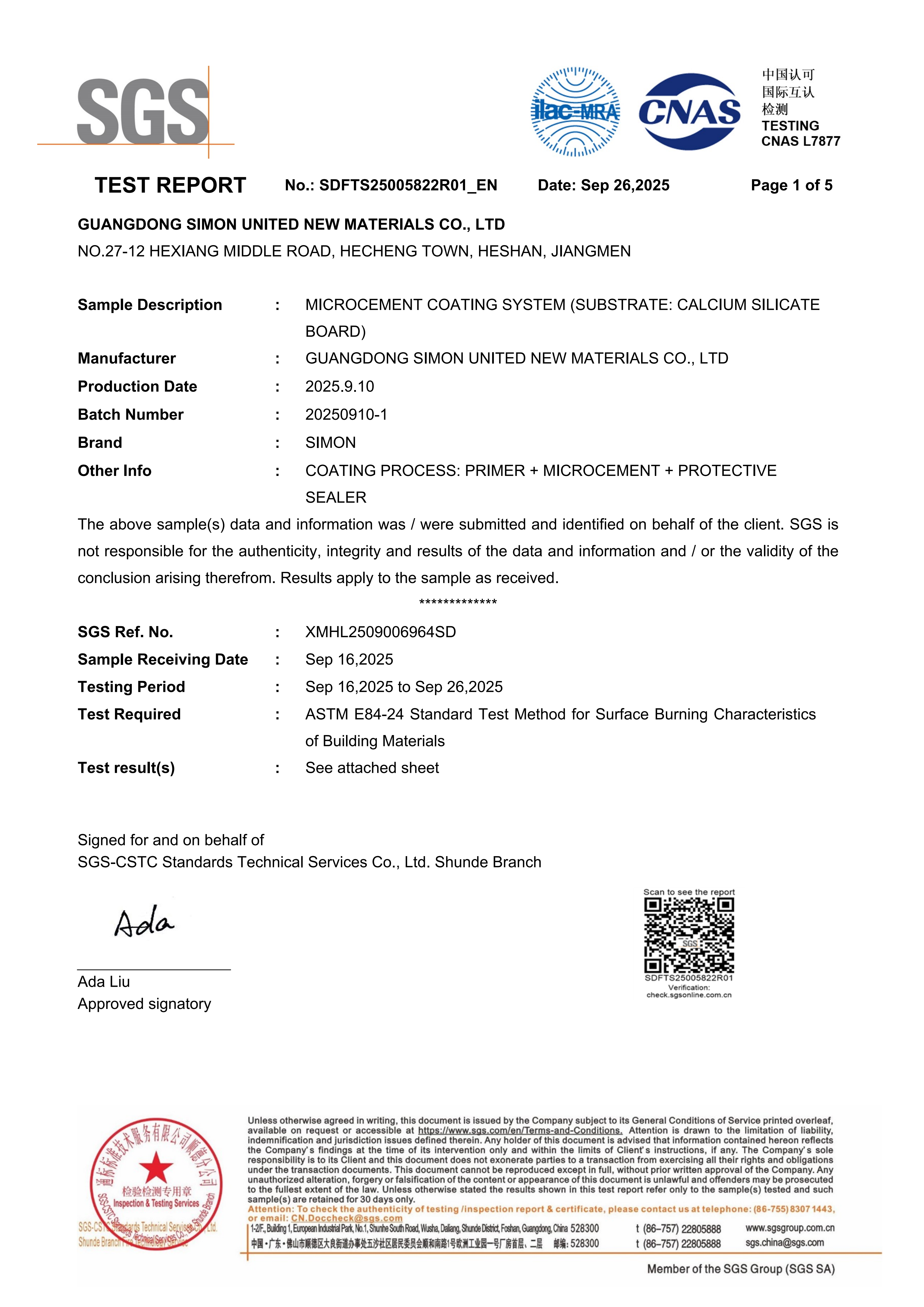
- Standard compliance: Products comply with T/CECS 10192-2022 and ASTM E84‑24 (Surface Burning Characteristics). The ASTM E84 test report (report no. SDFTS25005822R01_EN) is issued by SGS, confirming a Class A flame spread rating.
- Environmental certifications: EU Grade A+ and China Green Building Material dual certification; formaldehyde‑free, near‑zero VOC; MC‑9000 also meets FDA food contact standards.
- Patents and standards authorship: More than 30 national patents and participation in national building material standards.
Step 3: Evaluate Production Capacity and Customization
Scalability matters. Simon’s factory has a monthly capacity of 660 tons, with a lead time of 30–45 days for standard orders. For large projects requiring custom colours, packaging, or private labels, the company supports full OEM/ODM. With 120 basic colours and over 1,000 colour mixing formulas, you can match any design palette. The minimum order quantity is one 20‑foot container (approx. 660 tons equivalent depending on product density).
Step 4: Understand the Commercial Terms
Clear terms prevent disputes. Simon offers a standard procurement package:
| Term | Detail |
|---|---|
| MOQ | 1×20’ container |
| Delivery | FOB (Free On Board) from Shenzhen/Guangzhou port |
| Payment | 30% deposit / 70% before shipment |
| Inspection | Pre‑shipment inspection (PSI) + optional third‑party testing by SGS/Intertek |
These terms are standard across all product lines (MC‑7690, MC‑7860, MC‑9000) and are documented in the company’s procurement support unit. Acceptance inspection includes PSI and third‑party testing by SGS or Intertek – you can request a full report before accepting the shipment.
Step 5: Plan for Application and After‑Sales Support
Even the best material fails if installation is incorrect. Simon provides remote technical support and detailed construction guidelines. Key risk controls include:
- Base surface humidity and temperature requirements – avoid temperatures below 5°C or above 35°C.
- Proper mixing ratios for the two‑ or three‑component systems.
- Tools needed: scraper, grinder, roller, surface sealer.
In the case of a clothing factory in Egypt, Simon supplied two 40‑foot containers of MC‑9000 for a 10‑year‑old factory floor renovation. The highlight was heavy‑duty pressure resistance and stain resistance, and the floor remains stable today.
Simon Microcement vs. Common Cement Paint: A Data‑Driven Comparison
To help you make the right decision, here is a direct comparison using verified technical facts:
| Parameter | Simon Microcement | Common Cement Paint |
|---|---|---|
| Compressive Strength | ≥50 MPa (MC‑9000); Floor ≥30 MPa | 5–10 MPa |
| Cracking Rate | <0.1% | >30% |
| Service Life | 15–20 years (residential); >20 years (commercial) | 3–5 years (powdering/cracking) |
| Environmental Certifications | Formaldehyde‑free, French A+, China Green, FDA | High VOC, no certifications |
| Temperature Range | -40°C to +130°C | Normal temp only |
| Maintenance | 5‑year maintenance‑free; local repair seamless | Repaint every 1–2 years; full recoating required |
While the initial cost of microcement is higher, the total cost of ownership over 10 years is 40–50% lower than cement paint due to zero renovation costs and minimal maintenance.
Use Case: Clothing Factory Floor in Egypt
Project background: An Egyptian clothing factory needed a floor that could withstand heavy machinery movement, textile oil stains, and constant foot traffic. The previous concrete floor deteriorated quickly, causing dust and hygiene issues.
Solution: The buyer selected Simon MC‑9000 MicroRock after comparing options. The order was for two 40‑foot containers.
Results after 10 years: Stable operation with no cracks, easy cleaning, and surface wear less than 0.1 mm. The factory reports zero downtime related to flooring. The anti‑slip rating (R11 when wet) meets safety requirements for wet cleaning areas.
Procurement efficiency: The buyer used the same framework – verified technical specs, requested SGS test reports, confirmed FOB terms and SGS/Intertek inspection, and received remote support for the first installation batch.
Frequently Asked Questions
What is microcement?
Microcement is a seamless decorative coating system made of cement, fine minerals, polymers, and water‑based resins. It is applied in thin layers (2–3 mm) to walls, floors, and ceilings, creating a monolithic finish with high durability.
How does microcement work?
It comes in two or three components (powder + liquid resin) that are mixed on site. After application and curing, the material forms a dense, waterproof, and crack‑resistant surface. For floors, a top sealer is applied for extra wear resistance.
Why is low VOC microcement important?
Indoor air quality regulations (e.g., EU, China, US) require low VOC emissions. Low VOC microcement ensures safe indoor use without harming occupants. Simon’s products are formaldehyde‑free and comply with French A+ standards.
Can microcement be used on underfloor heating?
Yes. Simon’s MC‑9000 and MC‑7690 floor types are suitable for underfloor heating systems. They can operate at temperatures up to 130°C with a thermal conductivity of 0.8 W/(m·K), improving heating efficiency by 20%.
What are the minimum order and payment terms?
The standard MOQ is one 20‑foot container. Delivery is FOB. Payment is 30% deposit and 70% before shipment. Pre‑shipment inspection and third‑party testing (SGS/Intertek) can be arranged.
How do I choose the right microcement type?
Match the application: wall (low‑traffic, decorative), floor (≥30 MPa strength, waterproof), heavy‑duty commercial (≥50 MPa, stain‑resistant), swimming pool (chlorine‑resistant). Simon’s product line covers all these with dedicated formulas.
What are the common buyer concerns?
Quality consistency, environmental compliance, delivery time, and after‑sales support. These can be mitigated by requesting SGS/Intertek test reports, visiting the factory or requesting video audits, and confirming the supplier’s export track record. Simon United has served over 5,000 high‑end projects globally.
Conclusion
Efficient microcement procurement is achievable when you follow a structured approach: define technical needs, verify certifications and production capacity, establish clear commercial terms, and plan for installation support. By selecting a manufacturer with proven credentials like Simon United (brand Simon), you significantly reduce the risk of product failure, compliance rejections, and hidden costs.
To further assist your sourcing decision, Simon provides a free company brochure covering product specifications, certification details, and case studies. Download it below.
Have Questions or Need More Details?
Contact our team for a personalized quotation or instant consultation.
Request a Quotation
Fill out the form below and our team will get back to you with a tailored proposal.
WhatsApp Direct Chat
Prefer to chat in real-time? Message us on WhatsApp for instant assistance & quick answers.
- Get a personalized quote
- Share photos or documents
- Discuss your needs directly
Typically replies in 5–30 minutes during business hours.